Why Start with a Foundation in Science?
Every scientific discovery starts with a question. Whether you're curious about the human body, how diseases develop, or what data can reveal, a Foundation in Science helps you explore your interests, build essential knowledge, and prepare for your next step at university.
27 October 2026
Why does the human body respond to exercise? How do diseases develop? What can experimental results and patterns in data reveal about the world around us?
Although these questions explore different areas of knowledge, they share a common starting point: scientific inquiry.
For students preparing to enter university, a Foundation in Science programme offers an opportunity to build essential scientific knowledge, develop academic skills, and prepare for more advanced study.
1. Understanding the Big Picture
Science rarely exists in isolation. Its various disciplines are interconnected, each offering a different perspective on the world around us.
A solid understanding of scientific fundamentals provides the context needed to make sense of complex concepts.
Here at NUMed
The Foundation in Science programme introduces students to core scientific subjects relevant to their chosen pathway. Through biology, chemistry, physics, mathematics and statistics, students build the knowledge needed to approach more advanced scientific concepts.
By developing this knowledge progressively, students establish a grounding for their next stage of study.

2. Learning to Think
Much more than remembering facts, formulae, or definitions, scientific thinking involves examining evidence, questioning assumptions, recognising patterns, and approaching problems systematically. It encourages us to look beyond the first explanation and consider alternative possibilities.
These skills are valuable across many disciplines. A medical student may need to understand how different biological processes contribute to a disease. A researcher may investigate experimental results. An applied sport scientist may analyse physical performance and explore how the body responds to exercise, while a data scientist may identify patterns and test a hypothesis.
Here at NUMed
Learning extends beyond absorbing information in lectures. Through tutorials, seminar discussions, case studies, and project work, students are encouraged to engage with concepts, apply their knowledge, and develop their problem-solving abilities.
These experiences help students build the critical-thinking skills and independent learning habits needed to navigate the challenges of university education.
3. Connecting What You Learn with What You Do
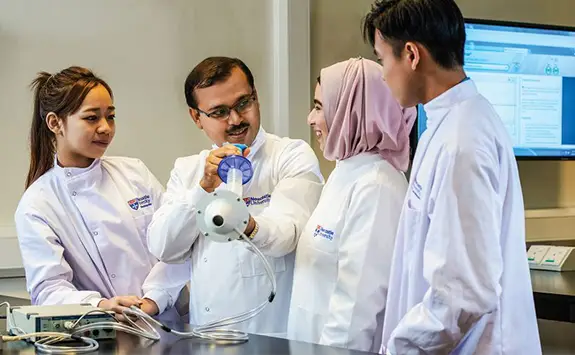
Understanding a scientific principle is one thing. Using it to investigate a question, conduct an experiment or interpret a result is another. Practical learning helps bridge this gap. Laboratory work allows students to explore scientific concepts through observation and experimentation.It also introduces the importance of accuracy, safety, and following appropriate procedures. These experiences help students develop the confidence to apply what they have learned, work through problems, and communicate their findings.
Here at NUMed
Practical laboratory sessions form part of the Foundation in Science programme, giving students opportunities to engage with scientific concepts beyond the classroom and helping them to connect theoretical knowledge with practical applications.
The experience also introduces students to the expectations of scientific work, including careful observation, following procedures, and interpreting results.
4. Preparing for the Next Stage of Learning
Moving from secondary education to university involves more than studying new subjects. Students must also adapt to a different approach to learning, where independent thinking, academic communication, and the ability to manage more complex information become increasingly important.
A strong grounding in science can help make this transition more manageable by introducing students to the knowledge and skills expected in higher education.
Here at NUMed
In addition to subject knowledge, the Foundation in Science helps students develop academic English and study skills. Learning activities such as essay writing, laboratory reports, and presentations help students become familiar with different forms of academic work.
Together, these experiences provide a foundation for the transition to undergraduate study, where students are expected to take greater responsibility for their learning.
5. Discovering Where Your Interests Can Take You
One of the most interesting things about science is that the same curiosity can lead in many different directions. You may begin your science journey with a particular interest but discover new possibilities as you learn more. A foundation in science helps you build the knowledge to explore different areas of study and make more informed decisions about your next steps.
Here at NUMed
Successful completion of the Foundation in Science programme at the required academic level can open progression opportunities to further study, subject to the relevant entry requirements and conditions.
Students may also explore eligible progression opportunities at Newcastle University in the UK.
Understanding the available pathways can help students make informed decisions about their academic goals and the subjects they want to pursue in greater depth.