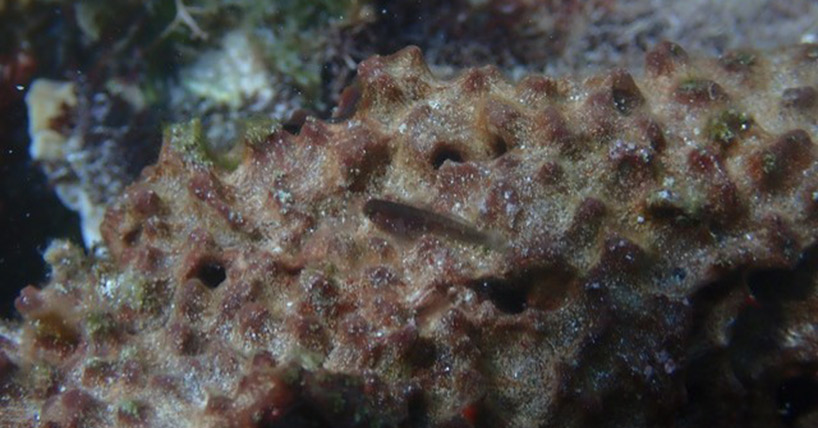
tusked goby and sponges
Research shows the influence of sponges on life inside coral reefs
Published on: 13 November 2026
New studies are helping reveal how sponges shape the lives of tiny coral reef fish.
Two new studies involving Newcastle University marine scientist Dr Theresa Rueger have highlighted how the tusked goby's relationship with its host sponge shapes almost every aspect of its life. Dr Rueger, Senior Lecturer in Tropical Marine Sciences at Newcastle University's School of Natural and Environmental Sciences, is senior author of one study and co-author of the other, which together uncover the influence of sponges on the tiny Caribbean reef fish's social behaviour, growth, reproduction and microbiome.
The two complementary studies were led by the University of Texas at Austin Marine Science Institute and include experts from Newcastle University, the University of Belize, the College of Charleston, and the University of Washington.
Sponges shape nearly every aspect of tusked goby’s life
In one study, published in The American Naturalist journal, researchers revealed that the sponge structures the goby’s (Risor ruber) social world. Large sponges were more likely to contain R. ruber, supported larger groups, and hosted larger dominant individuals. Within the sponges, gobies formed clear size-based social hierarchies, showing how the physical capacity of a host sponge can organize interactions among its residents. At the same time, genomic analyses found no evidence that fish living together in the same sponge were more closely related than fish living in different sponges, suggesting that these social groups are structured primarily by ecological constraints rather than family relationships.
A second study, published in Molecular Ecology, revealed an extensive overlap related to their microbiome. More than 500 bacterial sequence variants were detected in both R. ruber and the sponges, with particularly strong representation of sponge-associated microbes in the goby gut – far exceeding what was found in another sponge-associated goby, in the surrounding environment, or by chance. This striking overlap underscores a unique microbial connection between the tusked goby and sponges.
Dr Rueger said: “This research is about a tiny goby which leads a very unusual life deep in sea sponges. What our two studies show is that their lives are completely shaped by where they live, from their gut microbiome to the structure of their social groups. This research underlines how important sponges are as habitat and how much we have to learn about many overlooked animals in our marine habitats."
The findings highlight an often-overlooked role of sponges on coral reefs. While corals typically receive much of the attention as reef-building organisms, sponges create complex habitats that support diverse communities of small and cryptic animals. Changes to sponge abundance, health, or physical structure could therefore affect their residents in ways that extend far beyond simple habitat loss, potentially impacting microbial associations, social systems, and reproductive dynamics before changes are visible at the population level.
By studying one of the reef’s smallest and most specialized fishes in the Caribbean, the researchers show how relationships operating within just a few centimetres of seascape can influence biological processes ranging from microorganisms to populations.
The research was supported by the University of Texas Marine Science Institute and the Natural Environment Research Council (NERC), with fieldwork conducted at the Smithsonian’s Carrie Bow Cay Research Station in Belize.
Reference:
Vasconcellos Bunholi, I., Affleck, A., Do, M. C., Johnson, K., Ortega, R., Jensen, E., Tornabene, L., Brandl, S. J., Casey, J. M., & Rueger, T. (2026). Ecological constraints of habitat specialization shape the social organization and life history of a sponge-dwelling goby. The American Naturalist. https://doi.org/10.1086/744315
Vasconcellos Bunholi, I., Affleck, A., Johnson, K., Ortega, R., Freeman, C. J., Rueger, T. & Casey, J. M. (2026). Cryptic Interactions in a Marine Microcosm: Sponges Shape the Microbiome of a Resident Goby. Molecular Ecology, 35(16), e70523. https://doi.org/10.1111/mec.70523
Press release adapted with thanks from the University of Texas.
.jpg)