


Archaeology students Redesdale 2026
Archaeology students find Roman treasures on first excavation
Published on: 18 November 2026
Archaeology students from Newcastle University have unearthed an extraordinary range of Roman artefacts during their annual training excavations.
The discoveries include gold jewellery, inscriptions, and a finely carved gemstone, and were made at a site in Redesdale, Northumberland.
The excavations form part of a long-running research project investigating the structures, industries and activities that supported life on Rome's northern frontier.
This year's excavation, which took place in summer 2026, brought together 52 first-year archaeology students, divided into two groups, each spending two weeks on site. The students worked alongside volunteers from the Redesdale Archaeology Group (RAG), with the excavations directed by The Archaeological Practice Ltd.
While archaeologists routinely recover artefacts from Roman military sites, the quantity and quality of this year's finds have surprised even experienced researchers.
Gold Chain Discovered on the First Day
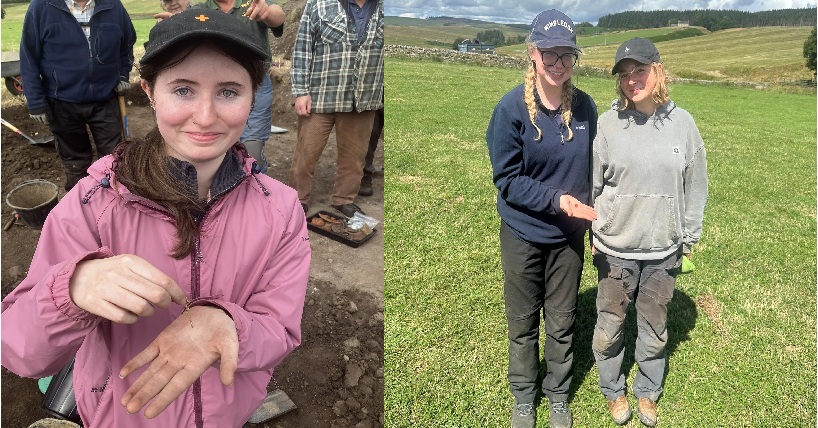
The most spectacular discovery was on the very first day of excavation when student Elise Zallu uncovered a section of Roman gold chain.
The fragile chain is approximately 7 cm long and remains in such remarkable condition that, if complete, it could still be worn today.
Commenting on her discovery, Elise said: “Finding the gold chain was really surreal, especially given it was the first day of my first dig. I didn’t expect to find anything like that my whole career, so it was definitely a surprise. I’m really grateful that studying archaeology at Newcastle has given me the opportunity to gain such valuable experience in the field which I feel will really benefit me in the future.”
The chain was manufactured using the sophisticated Roman loop-in-loop technique, a hallmark of high-quality Roman goldsmithing. Rather than using simple circular links, individual rings were carefully pinched into figure-of-eight shapes, folded, and then interwoven to create a flexible chain. Objects of this type were typically produced from exceptionally pure gold and are often associated with elite jewellery, decorative military amulets, or specialised fittings belonging to high-ranking officers and their families.
Dr Eric Tourigny of Newcastle University’s School of History, Classics and Archaeology, said: "Finding a gold artefact is something many archaeologists can go an entire career without experiencing. For a first-year student to discover a beautifully preserved Roman gold chain on their first day in the trench is truly remarkable."
Mysterious Inscribed Lead Object
Also on the first day, student Shannon Wood discovered a folded piece of lead bearing traces of a Latin inscription.
The small lead sheet carries partially obscured cursive lettering scratched into its surface. Archaeologists believe the object is most likely a commercial seal associated with trade, taxation, ownership, or the movement of goods through the Roman military supply network.
A second possibility is that it functioned as a personal message or curse tablet. Across the Roman world, individuals frequently scratched prayers, grievances, requests, and occasionally curses onto thin sheets of lead before folding and depositing them in sacred places.
Further study of the inscription is expected to reveal more about its purpose.
High-status cavalry fitting found on day two
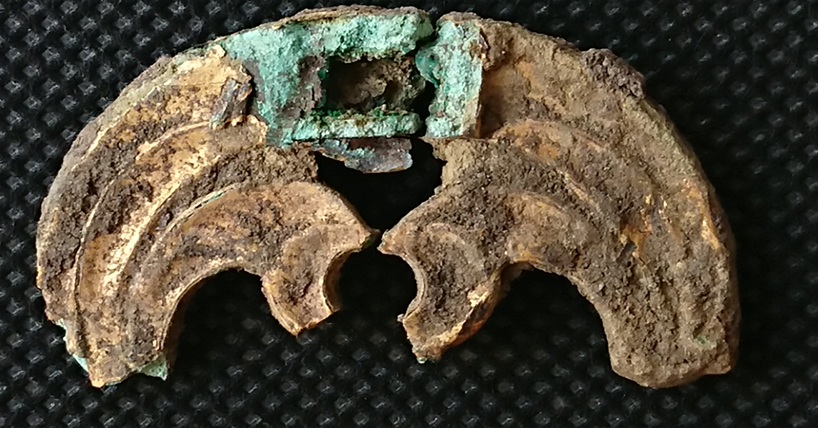
On the second day of excavations student Megan Potter uncovered a finely decorated Roman military fitting with traces of surviving gold gilding.
The object, above, has been identified as a peltate cavalry dangler, a decorative bronze mount that would originally have been attached to a military belt (cingulum), horse harness, or possibly the lower fitting of a sword scabbard. Such fittings formed part of the elaborate equipment used by Roman cavalrymen and officers, serving both practical and decorative purposes.
The artefact features a distinctive pelta design, a crescent-shaped motif derived from the small shields associated with Classical warriors. The curved ends of the crescent turn inward toward a central axis, while the front surface is decorated with carefully moulded concentric ridges, a style commonly found on high-quality Roman military fittings.
Although heavily corroded after nearly two millennia in the ground, it is in remarkably good condition with much of its gilding in place, indicating that the fitting originally had a striking gold appearance. Objects of this quality would have been costly and highly visible, signalling status and prestige within the Roman military hierarchy.
Archaeologists believe the find may have belonged to a cavalry officer or another high-ranking individual, and could point to the wealth and military importance of Rome's northern frontier.
Students also recovered a wide variety of Roman artefacts including coins, spearheads, dress accessories, pottery and other everyday objects, including numerous examples of Roman graffiti scratched onto pottery vessels.
One particularly well-preserved example comes from a Samian ware (terra sigillata) bowl bearing the scratched inscription of either "MARTIN[I]" or “MARTIN[US]”, likely referring to an individual named Martinus. Several other pottery fragments recovered this season appear to preserve the same name, suggesting ownership marks or personal identification added by someone who lived or worked at the site nearly 2,000 years ago.
Tiny Gemstone Reveals Jupiter
One of the final major discoveries of the excavation season came during the closing week when students Maisy Watmough and Zoe Yuill uncovered a beautifully carved carnelian intaglio.
Intaglios were engraved gemstones mounted in rings and used as personal seals. Their carved surfaces could be pressed into warm wax to authenticate documents and identify their owners.
The Redesdale example is carved from polished orange carnelian and depicts Jupiter, king of the Roman gods. The deity is shown holding a sceptre and a miniature figure of Victory, while an eagle sits at his feet.
As the supreme god of the Roman state, Jupiter symbolised military authority, imperial power and divine protection. His image was popular among soldiers, administrators and wealthy civilians throughout Roman Britain.
The discovery is the fourth intaglio recovered from the site. Two additional examples were discovered during the 2025 excavation season, while a further specimen was found during the nineteenth-century.
Commenting on her time on the excavation, Maisy said: “It was so exciting to find the intaglio. Studying archaeology at Newcastle has benefitted me in terms of experience and working in a professional setting. Working with archaeologists has allowed be to gain a better understanding of the practice and engage with new people.”
Zoe, also studying for her BA Hons Archaeology degree, added: “I loved my time at the field school, especially as everyone there was so friendly and helpful.”
Richard Carlton, Site director and Visiting Fellow in Archaeology, Newcastle University, said: "These finds are exciting not only because of their quality, but because of the stories they tell. A gold chain, a signet gemstone, inscribed pottery and a decorated brooch illuminate the lives of the people who made this site work almost two millennia ago. Combined with the buildings and industrial features the team is excavating, they also help us understand how the frontier operated, and how Roman and Native communities interacted."
The site in Redesdale has been investigated by Newcastle University staff, students and partners since the early 1990s, with major excavation campaigns undertaken between 1992-1998 and 2010.
The current project, which began in 2021, has so far explored the buried remains of two large enclosures, or ‘annexes’ including their defences, internal buildings and roads, as well as evidence for industrial activities.
Understanding these areas is vital because there would have been an extensive supporting landscape of workshops, industrial installations, supply depots, traders, families, and other infrastructure. The research is helping archaeologists reconstruct how these frontier communities operated and how soldiers, civilians and traders interacted along the northernmost edge of the Roman Empire.
.jpg)
