Euclid data release
Revealing our largest and sharpest ever views of the Universe
Published on: 12 November 2026
Newcastle research is helping unlock the secrets of the Universe as the Euclid space telescope reveals the sharpest images of the cosmos yet.
UK astronomers involved in the European Space Agency’s Euclid mission have used breakthrough techniques to reveal our largest, sharpest images of the cosmos yet.
This latest data release, known as DR1-Foundation, covers an area of sky as big as 9500 full Moons from just one year of observing. Some 900 million galaxies are captured in incredible detail with the involvement of cutting-edge UK research.
Dr James Nightingale, an astronomer at Newcastle University, has developed software that is helping researchers analyse thousands of gravitational lenses captured by the space telescope – a dramatic increase in the number of these rare cosmic phenomena available to study.
Euclid is now transforming our understanding of the Universe. A flurry of discoveries is announced today (12 November) that includes the combined efforts of UK astronomers, the public, and AI, contributing to our largest ever catalogue of warped galaxies. This just one of the clues that will unlock the mysteries of dark matter and dark energy, shedding light on our place in the Universe.
In collaborating with partners around the world, British technology and expertise is enabling groundbreaking discoveries with Euclid using state-of-the-art algorithms and cameras, thanks to £54 million of investment from the UK Space Agency in the mission.
The Euclid space telescope
Launched in July 2023, the Euclid space telescope is on a mission to map one third of the sky in exquisite detail. This is made possible by an onboard visible instrument (VIS), with its design and build led by University College London’s Mullard Space Science Laboratory (MSSL).
A team of seven UK universities, led by the University of Edinburgh, is also designing brand new analysis pipelines to push forward groundbreaking science within Euclid’s large datasets. Known as the UK Science Ground Segment, they work behind the scenes to account for the effects of radiation on the detectors and understand the telescope’s optics to measure the properties of galaxies with incredible precision.
This latest release, while a huge section of the sky, is still just a small part of what will become Euclid’s complete cosmic atlas. Even so, it is 1.7 million gigabytes in size, equivalent to a mixtape that would take 2,000 years to listen to.
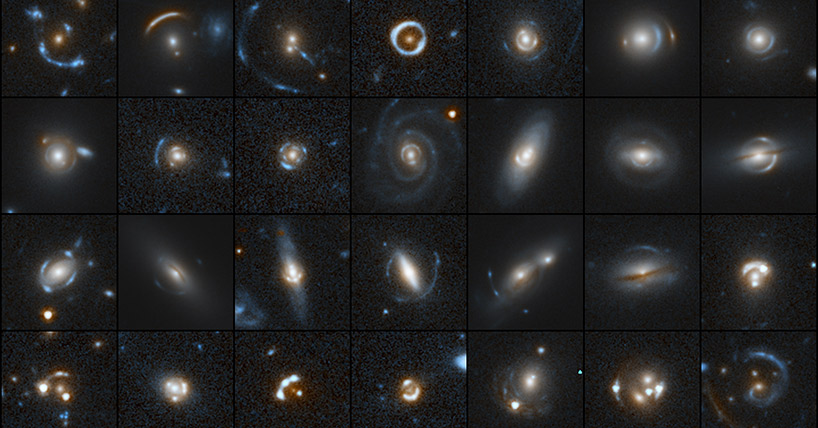
Thanks to a UK-led effort with teams based at Portsmouth, Newcastle, and Oxford, Euclid is revolutionising the number of these we can find, with more than 15,000 catalogued in this dataset alone. These objects are now abundant clues for scientists to understand the mysteries of the influences we can’t see directly but dictate how the Universe formed and how it ultimately ends – dark matter and dark energy.
Dr Nightingale, of Newcastle University's School of Mathematics, Statistics and Physics, developed the software used to analyse Euclid’s 15,000 strong gravitational lenses.
He said “When I began studying strong lensing in 2012, I had just 50 lenses to work with. Now, with Euclid, we need to analyse that many every hour just to keep up.”
“By doing this for thousands of galaxies we can begin to answer much bigger questions: how do galaxies grow, where is their matter, and what does this tell us about the Universe as a whole?”
A gamechanger for astronomy
Professor Andy Taylor of the University of Edinburgh, who leads the UK Science Ground Segment for the mission, says “These huge, ultra-high-definition images from Euclid are a gamechanger for astronomy. Euclid is proving itself to be a Super-Hubble Space Telescope, with the same high resolution but over large areas of the sky, taking just days to see more of the cosmos than Hubble has ever seen in its decades of operation.
“It is an exciting time for astronomy as we turn these amazing images into 3D maps of the Universe, creating a laboratory to probe dark matter and dark energy.”
Within this unfurling map are illusions of spacetime, known as strong gravitational lenses, where light rays from background galaxies travelling on a path toward us bend due to the presence of heavy objects such as galaxies and galaxy clusters.
Contributing to the strong gravitational lens classifications have been members of the public, thanks to a citizen science project hosted on the Zooniverse platform – Space Warps.
“These spectacular discoveries were only possible thanks to the powerful combination of machine learning classifiers and the incredible contributions of thousands of citizen scientists. These volunteers made over 4 million classifications and their efforts were truly humbling - the incredible strong lens systems we have found are a testament to the huge team effort which has gone into identifying them.” said Philip Holloway, Research Fellow at the University of Portsmouth.
Researchers from across the UK have recently engaged with the public at events including the Royal Society’s Summer Science Exhibition and New Scientist Live, providing additional opportunities to get involved in the Euclid mission.
“Euclid’s dataset isn’t just for scientists, it’s for all of us. Each jigsaw piece that gets added to this remarkable cosmic atlas tells us more about humanity’s place in the Universe, and today’s release gives us our clearest view yet.” says James Fawcett-Newell, UK Public Engagement Lead for the Euclid mission.
“We’re excited to continue involving the public, schools and communities in Euclid’s discoveries and signposting the varied career opportunities in such a mission.”
Attention will soon turn to how the countless objects catalogued by Euclid can reveal more about the dark matter and dark energy that makes up 95% of the Universe, in a way that ground-based telescopes alone cannot. The first cosmology results are expected in 2027.
Press release with thanks from the University of Edinburgh on behalf of Euclid UK members.
.jpg)