Computing student nominated for UK StartUp Award
MSc student Luke Henderson has been nominated for his startup, which helps neurodivergent people to manage their finances
22 May 2026
School of Computing Masters student, Luke Henderson, has been nominated for an award at this year’s UK StartUp Awards.
Luke runs NeuroMoney, an ADHD- and autism-friendly money management and shopping tool for neurodivergent adults. The business has been nominated in the 'StartUp for Good' category, for startups which are creating positive social change.
Luke is currently studying for a Masters in Data Science and Artificial Intelligence and here explains more about NeuroMoney, his personal experience of neurodiversity, and how the skills he is developing through his Postgraduate degree have been instrumental to the business’ success.
Why did you decide to start NeuroMoney? Was there a reason you chose to support neurodivergent people in particular?
I have been interested in technology and computing for most of my life. I started teaching myself C and programming at around the age of 10, before later moving on to Python and Visual Basic at school.
At 15, during my GCSEs, I was diagnosed with Autism Spectrum Disorder Level 1, which at the time was commonly referred to as Asperger’s. When I moved out during my undergraduate studies, I found independent living (especially managing my personal finances) particularly challenging.
I was later diagnosed with ADHD Combined Type, which helped me better understand many of the difficulties I had experienced. Around the same time, I had the opportunity to work commercially with Python, which gave me the skills and confidence to start building my own software.
I had always wanted to create my own platform, but I did not know exactly what it would be. Eventually, I realised the most meaningful thing I could build was something that would help people like me. The original idea was a shopping and financial planning tool that would help me manage recurring purchases, bills and subscriptions without constantly having to remember and reorganise everything manually.
.jpg)
Although it may not sound like the most glamorous business idea at first, it is something I personally identify with very strongly. As someone who is AuDHD, I also have friends and family members who are neurodivergent, and when I discussed the idea with them, the feedback was overwhelmingly positive. Many people said it was something they would find extremely useful.
NeuroMoney has developed from that initial idea into a financial management platform designed with neurodivergent adults in mind. While it is not exclusively for neurodivergent users, they are the core group I am building for. Many budgeting apps claim to support neurodivergent people, but their user experience often does not reflect how people with ADHD, autism, dyslexia, dyspraxia or dyscalculia may actually interact with money, planning and organisation.
For me, the most exciting part of launching NeuroMoney was that I finally had access to the kind of tool I had needed myself but had never been able to find.
Is this your first business, or have you had any previous business experience?
NeuroMoney is my first formal business venture. As a teenager, I was self-employed as a video editor and was involved in running online gaming organisations with friends, including social media channels that reached around 10,000 users. However, those projects were more hobby-based and creative than structured businesses.
How has your MSc and the skills you have learnt at Newcastle University helped with your business?
My MSc has helped me better understand data pipelines, analytics, user behaviour and how to visualise data effectively, one of the core elements of making NeuroMoney simple and not overwhelming. These skills are directly relevant to understanding how users move through the platform, where they may struggle, and how I can improve the user experience to increase retention, engagement and conversion.
The course has also helped me understand how AI can be used practically and responsibly. This has already helped me speed up content generation and operational tasks, allowing me and my voluntary content writer to focus more time on building the platform itself.
In the future, I also plan to explore how large language models could be integrated into NeuroMoney to help automate tasks for users that may otherwise be difficult or overwhelming through traditional software alone.
How has Newcastle University supported you with your business?
So far, I’ve had one meeting with the START UP team. They provided useful contacts and assigned me a business adviser, who I am due to meet with.
That initial support has been really valuable because it helped me understand what is available to students in terms of business advice, funding opportunities, workspace and wider entrepreneurial support across the University.
What are the next steps for your business?
The next stage for NeuroMoney is focused on growth, distribution and product development.
Over the past few weeks, we have been building a stronger social media pipeline across LinkedIn, TikTok and Instagram. This is becoming a major part of our distribution strategy, alongside our SEO (search engine optimisation) and blog content.
As a result of these efforts, we have started gaining new users on an almost daily basis. Over the next month, the focus will be on continuing to build awareness and engagement, before moving further into product development.
The next product steps include improving the app’s infrastructure, adding new features, refining the user experience and creating more value for users, with the aim of converting our already growing userbase into paying users.
Business Success
NeuroMoney is still in an early stage, but we are already seeing encouraging results.
At the moment, we have around 45 active users and approximately 60 sign-ups in total.
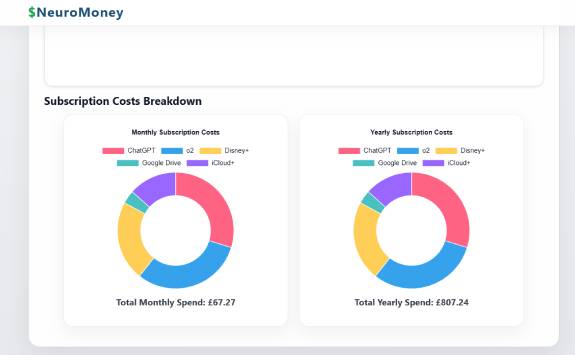
I have spoken to users who have reached out to say that even in its current form, NeuroMoney has helped them audit their finances and list their recurring payments more clearly. Both users said this helped them avoid late fees they had previously struggled with, particularly due to time blindness and difficulty keeping track of payments.
They also discovered subscriptions and bills they did not realise they were still paying for. One user estimated they had saved up to £500 annually by identifying wasted subscription costs, while another estimated savings of around £200.
Although these are early-stage results, they are very meaningful for NeuroMoney. They show that even at this stage, the platform is already helping users improve financial awareness, reduce unnecessary costs and feel more in control of their money.