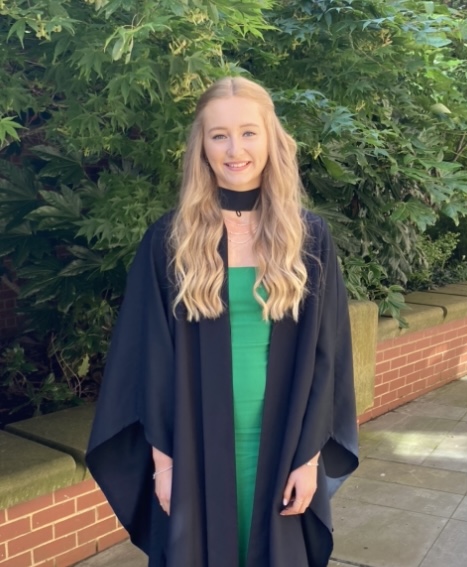
Millie Elcock
Millie graduated with an MDiet degree in 2024 and is now working as a Senior Dietitian at South Tees Hospitals NHS Foundation Trust
I qualified as a registered dietitian in 2024 after completing the Master of Dietetics programme at Newcastle University. I started in 2020 in the first cohort of students on their new dietetics programme. My first year was mostly online due to the coronavirus pandemic, therefore the first year of the course was different than we had all expected. However, from second year onwards teaching had mostly resumed in person, and I could start to really feel like a student at Newcastle University.
The programme covers a variety of different modules, including human physiology, bioenergetics, personalised nutrition, and nutrition through the lifecycle. The dietetic modules covering therapeutic diets and clinical medicine were extremely useful and the dietetic teaching staff had worked in a variety of different areas both within the NHS and external organisations – this demonstrated the breadth of dietetic opportunities and where dietitians can make an impact. Workshop style sessions helped me to practise applying knowledge to clinical scenarios with the support of peers and dietetic staff, which meant I felt prepared and ready to go out onto placements which are required as part of the dietetics degree. For my placements, I spent 12 weeks at South Tees Hospitals NHS foundation trust, and 12 weeks at South Tyneside and Sunderland NHS foundation trust, which provided me with a range of experiences including care of the elderly, diabetes and gastroenterology, within both acute and community settings. As part of the master’s modules, I also completed a research project and a quality improvement project around patient catering at my placement site. The wealth of different experiences throughout my degree helped me feel confident going out into the workplace as a newly qualified dietitian.
After graduating, I started working in my first Band 5 dietitian job within an acute NHS trust. The job is a rotational post so I will change department every 9 months, giving me exposure to a few different clinical areas to determine where I may want to specialise in the future. My first rotation is within stroke, so the post has involved supporting patients with enteral feeding, nutrition support, and swallowing difficulties where texture modified diets are required. I am really enjoying my first role, and feel my experiences gained throughout the degree at university meant I felt ready to get started in it. I am looking forward to developing my knowledge in stroke further before rotating to another speciality, and also beginning to support students through their own placement experiences.
Update December 2024:
I felt ready to go out as a registered dietitian at the end of the course, and I feel the course really sets you up with strong foundations. The placements helped me to transition into my band 5 role smoothly as placement C ends with consolidation where I managed my own caseload of patients independently. The master's modules also meant I was not just thinking about clinical practice, but also how to get involved with research and quality improvement - the course not only teaches you theoretical knowledge but also how to apply it. I was extremely nervous before starting my first band 5 job, especially as I was going to work on hospital wards which I often found quite overwhelming on previous placements. However, the support I received from my new team and the four-week induction timetable eased me in, and I shadowed different members of the MDT which meant that staff on the wards quickly became familiar.
I am currently working in stroke, and I love the multidisciplinary team approach to working with patients who have had a stroke. I enjoy working with patients from admission who are started on enteral feeding and supporting them through their rehabilitation journey. This may involve weaning patients of enteral feeding, onto texture modified diets as their swallow improves, or it may be supporting patients whose swallow remains unsafe to consider longer term options such as a long term feeding tube or eating and drinking at risk. This involves working closely with the speech and language therapy teams, and attendance at weekly MDTs.
Update January 2026:
My second rotation was a split role between general medicine and older adults, and I enjoyed the variety within the split role. The new team were supportive, and we had regular caseload reviews to discuss patients and share ideas, and this was a great way to learn about the dietetic management of more complex patients that weren’t directly under my care. The role involved a mixture of enteral feeding and oral nutrition support across a variety of conditions. I also started to spend more time with students on their placements, supporting them to develop their clinical skills and confidence, completing weekly reviews and completing their placement assessment tools. I also started to work on team projects to try and improve nutritional care across our wards.
I have since finished in my first role and am now working as a senior dietitian at South Tees Hospitals NHS foundation trust, where I completed my B placement. This is an extremely varied role, and I also wanted to gain community experience which this role offered. I am now working across acute and community nutrition support, stroke rehabilitation, home enteral feeding and palliative care. The role also includes triaging new community referrals which was a new skill to learn. My experience from my first rotational role has really helped me settle into my new role, but there has also been lots of learning around community dietetics and new processes and policies to become familiar with. I enjoy being able to review patients on the ward and then being able to follow them up in the community and continue to support them to achieve their nutritional goals. I have lots of ideas for service improvement initiatives and I am looking forward to starting to work on these as I become more settled into the role.