Teacher Training Workshop
24 January 2026
Confucius Institute at Newcastle University Hosts Its First Teacher Training Workshop of 2026
On Saturday, 24 January 2026, the Confucius Institute at Newcastle University successfully hosted its first teacher training workshop of the Year of the Horse, marking the official launch of a new year of professional development for its teaching team. Aimed at enhancing classroom management skills and practical teaching techniques, the workshop invited James Renwick (Chinese name: 仁杰明) as the keynote speaker.
James is a local teacher at Oakfield Junior School, Gateshead, with extensive frontline teaching experience and a high level of fluency in Chinese. He is a graduate of Newcastle University, where he majored in East Asian Politics, and he also studied Chinese for one year at Renmin University of China. As a passionate advocate of the Chinese language, Chinese culture, and the Chinese people, James has played a key role in initiating and sustaining the long-term partnership between the Confucius Institute at Newcastle University (NUCI) and Oakfield Junior School. This collaboration has now continued for nearly 12 years, making Oakfield NUCI’s longest-standing partner school and the school that has contributed the largest number of pupils to Chinese language learning as part of its weekly curriculum. During the workshop, James delivered a rich, engaging, and highly practical training session for the Confucius Institute teaching staff.
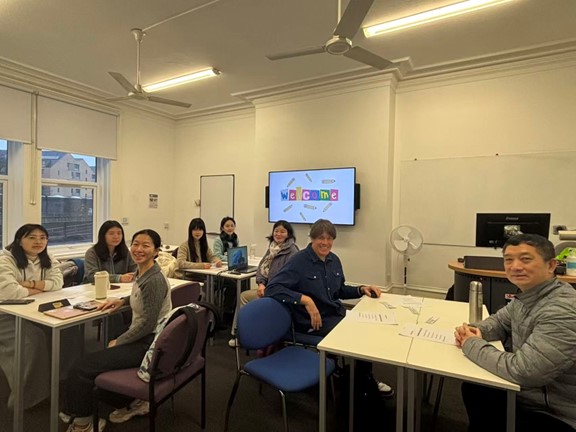
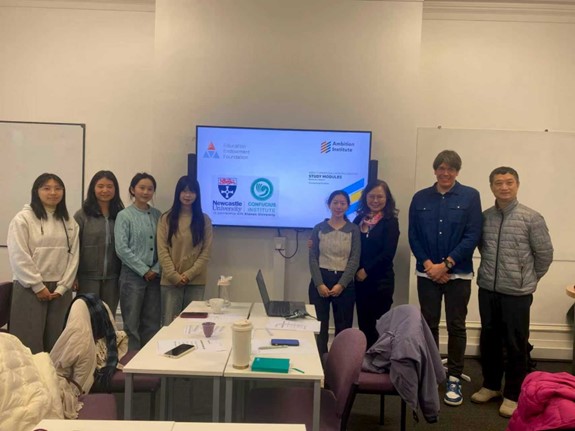
Led by Professor Yuxiao Su, Chinese Director of the Confucius Institute at Newcastle University, the workshop brought together four government-dispatched teachers, two volunteer teachers, and one specialist physical education teacher. All Confucius Institute teachers made full use of their weekend time to participate actively, engaging seriously in learning and discussion to further strengthen their classroom management skills and overall teaching competence.
The workshop unfolded in a relaxed yet highly interactive atmosphere. At the very beginning of the session, James impressed participants by communicating fluently and naturally in Chinese. Beneath his blond hair and blue eyes, his ability to conduct the session smoothly in Chinese left a strong impression on the teaching team. To energise the room and demonstrate an effective ice-breaking strategy, James opened the workshop with the well-known activity “Two Truths and a Lie.” He modelled the activity himself by offering three statements: (A) his father was a postman; (B) he had lived in Australia; and (C) he had once danced with the singer A-Mei (Zhang Huimei). The humorous and intriguing content immediately sparked lively discussion, with teachers eagerly guessing which statement was false, and the workshop officially began in a cheerful and engaging atmosphere.
James then invited each participating teacher to practise the activity themselves, enabling them to experience firsthand how this simple yet effective technique can quickly build rapport with students. He pointed out that Confucius Institute teachers in the Newcastle area often work as non-core subject teachers in primary and secondary schools, usually meeting each class only once a week. This makes it particularly important to establish trust and connection with students within a short period of time. Interactive activities such as this can help teachers connect with students more quickly, laying a solid foundation for effective teaching.
In the second part of the workshop, James focused on the design and delivery of classroom instructions, outlining four core principles. First, teachers should use consistent instructions, supported by appropriate non-verbal cues such as gestures and eye contact. Second, instructions should be controllable, specific, and well structured, avoiding vagueness or randomness. Third, each teaching step should be simple and easy to remember, ensuring that all students genuinely understand and retain the instructions. Fourth, instructions should be delivered with an appropriate voice and tone, making them both clear and approachable.
In discussing classroom management strategies, James drew on real teaching scenarios to share a range of methods for supporting positive classroom behaviour. He emphasised that when dealing with low-level disruption, teachers do not need to intervene verbally immediately. Instead, they can use non-verbal strategies such as eye contact or moving closer to the student. At the same time, by promptly praising students who demonstrate appropriate behaviour or strong performance, or by offering small rewards such as stickers, teachers can reinforce positive behaviour and gently guide less focused students back to the learning task, achieving effective classroom management in a subtle and supportive manner.
With 13 years of teaching experience across music, Chinese, and physical education, and through his long-standing involvement with NUCI, James was invited in 2024 by Professor Yuxiao Su, Chinese Director of NUCI, to represent the Confucius Institute at the Fourth Chinese Teaching Championship for English-Speaking Countries in Europe. He won third prize, becoming the first British contestant and award recipient in the history of this major competition organised by the Center for Language Education and Cooperation (CLEC) in London.
At the conclusion of the workshop, James provided a systematic summary of the training content and proposed six practical recommendations: first, to develop a thorough understanding of each school’s behaviour management policies; second, to avoid overly long classroom instructions; third, to reinforce key instructions through repetition; fourth, not to rely excessively on PowerPoint slides, but to focus more on teacher–student interaction; fifth, to strictly follow the teaching syllabus; and sixth, to communicate proactively with fellow teachers and seek support when challenges arise.
The workshop was chaired by Professor Yuxiao Su, who also played a key coordinating role during the preparatory stage by proactively inviting James to serve as the keynote speaker. Under her careful planning, the workshop content was closely aligned with classroom realities, diverse in format, highly interactive, and rich in highlights, receiving unanimous praise from participating teachers.
Participating teachers widely agreed that the workshop was closely aligned with real teaching needs, combining solid theoretical grounding with strong practical applicability, and offering clear and workable ideas for future classroom teaching and management. Teachers noted that this “first teacher training workshop of the Year of the Horse” not only laid a strong foundation for the new year’s teaching work, but also reflected the Confucius Institute’s continued commitment to teacher development and ongoing improvement in teaching quality. Looking ahead, the Confucius Institute at Newcastle University will continue to organise a variety of teacher training activities to support professional growth and promote the high-quality development of Chinese language education in the local community.